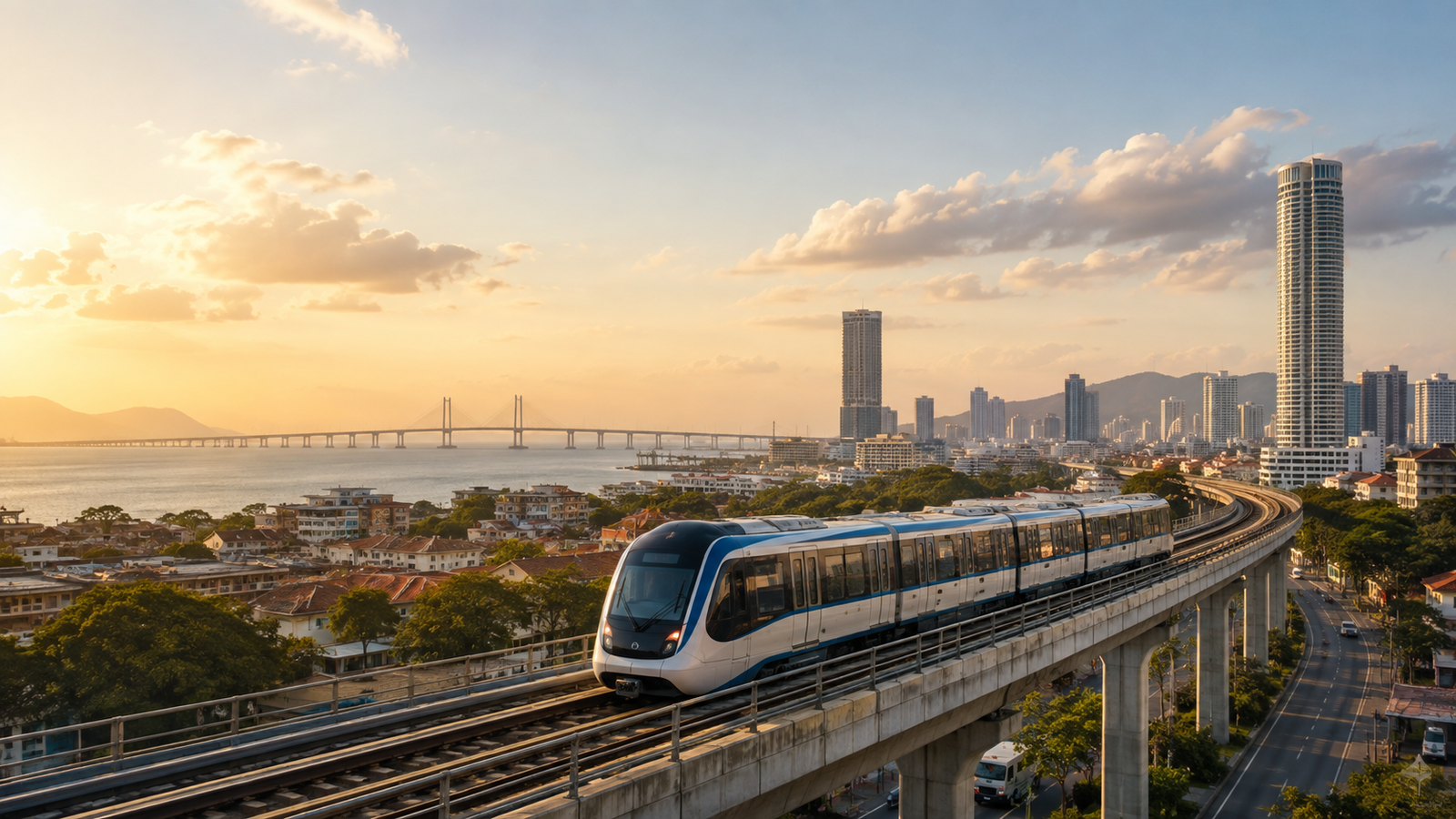
Penang’s upcoming Mutiara Line is more than a new public transport system. It has the potential to change how people move between homes, workplaces, commercial centres, the airport, George Town and the mainland — and whenever accessibility changes significantly, the property market usually pays attention.
A property being close to an LRT station does not automatically mean it will appreciate more. The better question is: what becomes easier to reach because of the station, and will enough people value that accessibility?
First, What Is the Penang LRT Mutiara Line?
The Mutiara Line is planned as the backbone of Penang’s future public transport network. MRT Corp’s current project information states a total viaduct length of 29.67 km, with 22 stations plus two provisional stations, linking Silicon Island to KOMTAR and Penang Sentral. A journey from Silicon Island to KOMTAR is expected to take around 45 minutes, while Silicon Island to Penang Sentral is expected to take around 49 minutes.
The official project timeline targets December 2031 for construction completion and the start of operations.
The Property Story Is the Corridor, Not Just the Station
The Mutiara Line links major employment, education, city-centre, airport and interchange nodes. The property impact should therefore be studied as a network.
Primary project information: MRT Corp — LRT Mutiara Line and MRT Corp FAQs.
LRT Does Not Create Property Value by Itself
Rail infrastructure primarily creates accessibility. Whether that accessibility translates into stronger property demand depends on what already exists around the station: jobs, population, businesses, schools, transport interchanges, walkability, development intensity and available housing supply.
A 2025 Malaysian study of the Sungai Buloh–Kajang MRT corridor found that properties near stations generally experienced positive pricing effects, but the benefits were not uniform. In some affluent neighbourhoods, homes extremely close to the rail track experienced negative effects, illustrating the importance of noise, nuisance and micro-location.
Research reference: Dziauddin et al. (2025), GEOGRAFI — Assessing the Impact of MRT on Residential Property Prices in Greater Kuala Lumpur.
1 Penang Sentral — Potential: Very High
If we look purely at transport network importance, Penang Sentral may be one of the most significant stations on the entire Mutiara Line. It connects the LRT with KTM Komuter, ETS intercity rail, Butterworth railway station, the ferry terminal and bus services.
This creates something particularly valuable in property analysis: network effect. A resident near an ordinary LRT station gains access to one rail line. A resident near Penang Sentral gains access to a much wider regional transport network.

Why it could matter for property
The surrounding Butterworth market historically operates at a different price level from prime Penang Island locations. If cross-strait connectivity becomes substantially easier, some households may reconsider the trade-off between island pricing and mainland accessibility.
Penang Sentral deserves close monitoring because the LRT does not merely improve local transportation — it changes Butterworth’s connection to the wider northern-region transport network.
2 Penang Waterfront — Potential: Very High
Penang Waterfront Station has a different investment story. Its advantage comes from location concentration: residential, commercial, convention, retail and waterfront uses within the same corridor.
A mixed-use destination can generate movement throughout the day — residents, office workers, convention visitors, hotel guests and retail customers — creating a broader demand ecosystem than a purely residential station.
Why it could matter for property
The Gelugor waterfront corridor already occupies a central position between George Town and southern Penang. The LRT therefore strengthens an existing location advantage rather than attempting to create demand from scratch.
Among Penang Island residential locations, the Penang Waterfront corridor deserves close attention because multiple demand generators are concentrated within one location. Entry price still matters.
3 KOMTAR — Potential: High
KOMTAR already sits at the heart of George Town. Its long-term value may come less from a dramatic “before versus after” transformation and more from its network role, central-city accessibility and possible future interchange function.
In mature locations, LRT impact may show up through improved rental demand, reduced dependence on cars, hospitality demand and selective redevelopment opportunities rather than a simple across-the-board price jump.
KOMTAR has very strong connectivity value, but investors should distinguish between a great station and a great property investment. Building quality, parking, management and micro-location still matter.
4 Sungai Dua – Sungai Nibong – Jalan Universiti — Potential: High
This corridor is interesting because the area already contains established housing, USM-related demand, interstate bus connectivity, access toward Bayan Lepas and mature daily amenities.
The LRT does not need to invent a reason for people to live here. It mainly needs to make an already useful location easier to access. That can be a healthier property story than relying entirely on future promises.
This corridor may not produce the loudest marketing story, but it has strong fundamentals because the LRT is being added to an area with established demand.
5 Bukit Jambul – SPICE – Jalan Tengah — Potential: High
The biggest advantage of this southern-central cluster is its relationship with Bayan Lepas. Many households choose where to live based on commuting convenience to Penang’s southern employment corridor.
If the LRT meaningfully reduces commuting friction, properties with good station access could become more attractive to both owner-occupiers and tenants. But actual walking routes, road crossings and feeder connectivity will matter more than simple straight-line distance.
6 FIZ North – FIZ South — Potential: High, but Different
The Free Industrial Zone stations should be analysed differently from residential stations. Their importance comes from concentrated employment demand. Thousands of people need to travel into Bayan Lepas for work, so the larger beneficiaries may be residential areas several stations away that suddenly gain easier access to the FIZ.
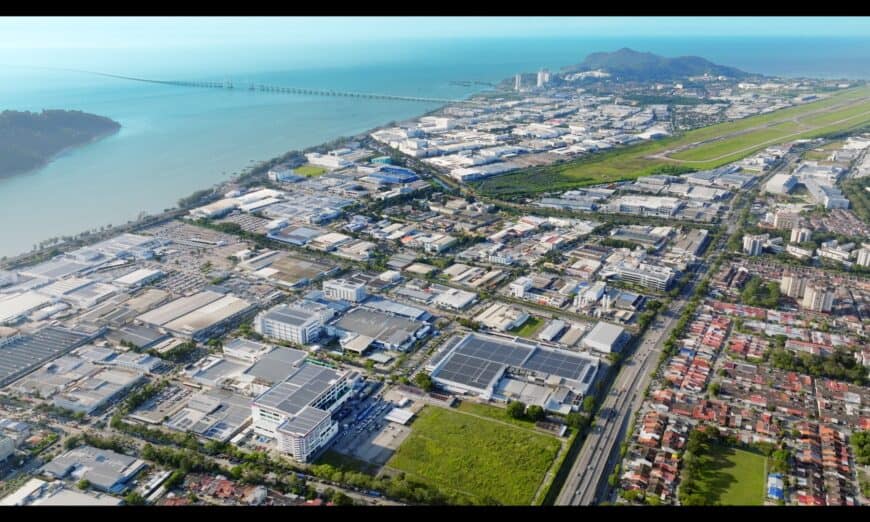
The FIZ stations could strengthen rental demand across a much larger residential catchment rather than creating a simple investment radius around the stations themselves.
What About Penang International Airport Station?
Direct rail access to Penang International Airport is strategically important, but the residential impact is more complex. Airports create accessibility, while also introducing aircraft noise, traffic, commercial land uses and development constraints.
The best residential beneficiary may therefore not be the property closest to the airport. A location several stations away with direct airport access but a better living environment could be more attractive.
The Bigger Winner May Be the Entire Corridor
One of the easiest mistakes in analysing rail infrastructure is trying to identify one “winning station”. Transport networks do not work that way. The more important improvement is that a resident’s reachable city becomes larger.
A household near Gelugor or the waterfront may gain easier access north toward George Town and south toward USM, Sungai Nibong, Bukit Jambul, FIZ and the airport. That network effect can matter more than the station name itself.
Propmula Location Potential Watchlist
Based on current station functions and surrounding demand generators, these are the locations we believe deserve particularly close monitoring as the Mutiara Line develops.
| Station / Corridor | Main Location Driver | Propmula View |
|---|---|---|
| Penang Sentral | Multimodal interchange + island-mainland connection | Very High |
| Penang Waterfront | Mixed-use waterfront + commercial + residential demand | Very High |
| KOMTAR | George Town core + future interchange potential | High |
| Sungai Dua / Sungai Nibong / Jalan Universiti | Mature residential + USM + transport hub | High |
| Bukit Jambul / SPICE / Jalan Tengah | Residential + commercial + FIZ accessibility | High |
| FIZ North / South | Major employment concentration | High — corridor effect |
| Penang Airport | Airport connectivity | Strategic, selective |
This is not a forecast of future property prices. It is a comparison of the location conditions that could support future demand.
Don’t Buy a Property Just Because It Is Near the LRT
The LRT can improve a location, but it cannot fix every property. Before paying a premium for an “LRT property”, check the following.
Final Thoughts
Penang’s Mutiara Line could become one of the most important changes to the state’s urban geography in decades. But the biggest property opportunity may not simply be “buy the nearest property to an LRT station”.
A better strategy is to identify locations where the LRT strengthens something that is already economically important: a major employment centre, a university, a city centre, a transport interchange, a mixed-use waterfront district or a mature residential neighbourhood that suddenly becomes easier to commute from.
That is why our current watchlist places particular emphasis on Penang Sentral, Penang Waterfront, KOMTAR, the Sungai Dua–Sungai Nibong–USM corridor, and the Bukit Jambul–SPICE corridor.
The LRT is only one part of the equation. The more important question is: what becomes easier to reach because of it?
- MRT Corp — LRT Mutiara Line project information
- MRT Corp — Mutiara Line FAQs
- Dziauddin et al. (2025) — MRT proximity and residential property prices in Greater Kuala Lumpur
Propmula’s station potential labels are editorial location assessments based on the station role, surrounding demand generators and accessibility logic described in this article. They are not price forecasts or guarantees of capital appreciation.
This article is intended for general property research and educational purposes. Infrastructure plans, station locations, completion schedules and surrounding developments may change. Property values are influenced by multiple market, economic and property-specific factors.